


Titanium Powder
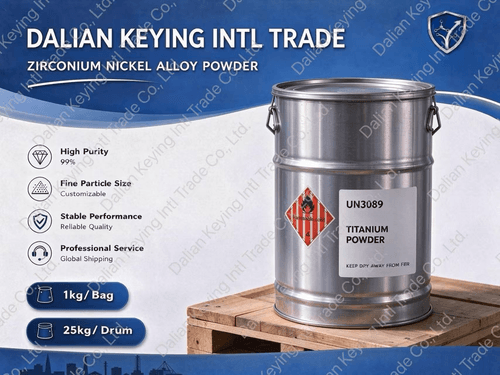
CAS No.: 7440-32-6
UN No.: 3089
Hazard Class: 4.1 (Flammable solid)
Purity: ≥99.5%
Appearance: Silver-grey metallic powder
Packing: Customizable
1. Product Overview
Titanium powder is a silver-grey metal powder produced from titanium sponge or titanium stock by the hydrogenation-dehydrogenation (HDH) process or by inert gas atomisation, with either irregular or spherical morphology. Titanium weighs about 57% of steel and offers high specific strength, corrosion resistance and biocompatibility, making it a key raw material for lightweight structural parts and functional materials. Our industrial-grade titanium powder covers -40 to -325 mesh with stable oxygen control, and is suitable for powder metallurgy, additive manufacturing, energetic materials and alloying applications.
2. Quality Specification (Typical, Industrial Grade)
Ti ≥99.5%; O ≤0.15%; N ≤0.03%; H ≤0.015%; Fe ≤0.05%; Si ≤0.02%; Cl ≤0.03%; Mg ≤0.02%; moisture ≤0.05%. Particle size is available at -40, -100, -200 or -325 mesh, or in the corresponding micrometre ranges, and spherical powder can also be supplied. The values above are typical for industrial grade; the actual specification is subject to the COA of each lot.
3. Product Advantages
Custom particle size: coarse, medium, fine and ultra-fine grades, sieved to the customer's mesh or micrometre range.
Tight impurity control with low oxygen and nitrogen, avoiding embrittlement in sintered parts and porosity in additively manufactured components.
Mature HDH process with consistent particle size distribution and apparent density between lots, giving uniform flow behaviour during forming.
Stable long-term capacity supporting both full-container bulk orders and small trial lots.
Complete documentation: COA, MSDS and dangerous goods packing certificate available for ocean shipment and destination customs declaration.
4. Applications
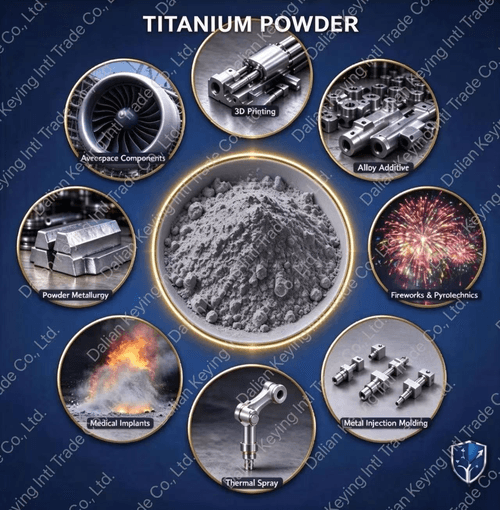
Lightweight aerospace structures and engine components; spherical powder for metal additive manufacturing (SLM, EBM); powder metallurgy sintered parts and porous filters; energetic materials (fireworks, propellants, igniters); alloy additives (Al-Ti-B grain refiners, deoxidation and alloying of steel); medical implants (joint prostheses, dental implants); thermal spray and surface hardening coatings; metal injection moulding (MIM) of precision small parts; and chemical catalysis and hydrogen storage materials.
5. Packing, Storage and Transport
Standard packing is a 25 kg iron or fibre drum with a double polyethylene liner, argon-filled and sealed; samples are supplied in 500 g bottles. Packing size and inert gas filling can be customised. The product should be stored in a cool, dry, well-ventilated dedicated warehouse, away from heat, ignition sources, oxidisers, acids and halogens, and protected from moisture. Ocean transport is arranged as UN 2546, Class 4.1, Packing Group II, with MSDS and the dangerous goods packing certificate supplied with the shipment.
6. Safety Notes
This product is a Class 4.1 flammable solid. Fine powder can form explosive dust clouds in air, so workplaces must be static-controlled, earthed and fitted with explosion-proof electrical equipment; dusting, friction and impact should be avoided, and it must not be stored or shipped together with oxidisers or acids. In case of fire, use dry sand, dry powder or a Class D metal fire extinguishing agent; never apply a direct water jet, as titanium powder reacts with water at high temperature to generate hydrogen and intensify the fire. Customers should carry out compatibility and small-scale testing before formulation.