

Go Back
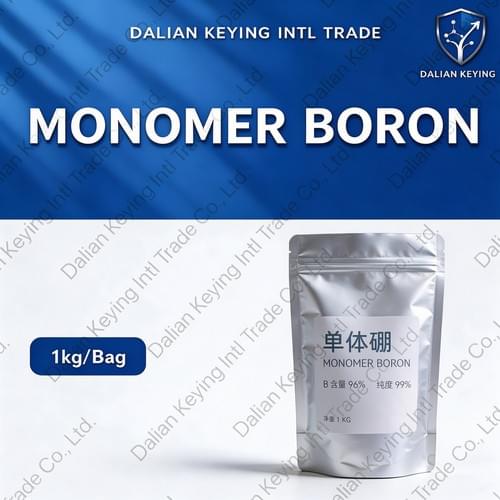
Monomer Boron
Boron has several allotropes; amorphous boron is also called element boron or monomer boron. It is a brown powder or grey shiny crystal with fairly active chemistry: stable in air at room temperature, oxidised at 300 °C and burning at 700 °C, with a red flame. It is insoluble in water, hydrochloric acid, ethanol and ether, dissolves in cold concentrated alkali to release hydrogen, and is oxidised to boric acid by concentrated nitric and sulphuric acids. At high temperature it reacts with oxygen, nitrogen, sulphur, halogens and carbon, combines directly with many metals to form borides, and reacts with organic compounds to give boron–carbon bonded products.
Monomer boron sits on the metal–nonmetal boundary of the periodic table and is predominantly non-metallic, with strong electronegativity, a small atomic radius and properties similar to silicon. Density 2.35 g/cm³; hardness 9.3; specific gravity 2.33–2.45; melting point 2300 °C; boiling point 2550 °C.
More Details