


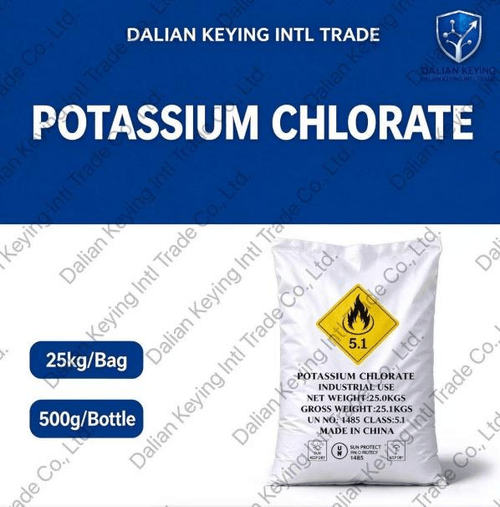
Potassium Chlorate
CAS No.3811-04-9
UN No.1485
Hazard Class 5.1
Purity ≥99%
Appearance: White crystalline powder
Packing: Customizable
Product Overview
Potassium Chlorate is a classic chlorate-based strong oxidizer produced via electrolysis. Through crystallization, recrystallization, sieving, and pulverization, we obtain products with varying particle sizes. It features high oxidative activity and a rapid oxygen release rate, making it a long-established raw material in fine inorganic oxidizing systems. Compared to potassium perchlorate, it releases oxygen faster at the same dosage, leading to higher formulation sensitivity. Due to its high reactivity, strict isolation from reducing materials is mandatory during storage and handling.
Quality Specifications (Typical Industrial Grade)

Product Advantages
Customizable Particle Sizes: Coarse crystals, medium crystals, fine powders, and ultra-fine pulverized grades are available, with sieving customized to client requirements.
Strict Impurity Control: Low bromate content prevents color interference and side reactions in formulations.
Electrolytic Process: Ensures uniform crystals, excellent flowability, and superior dispersion during powder mixing.
Stable Long-term Capacity: Supports full-container bulk orders and small-batch samples.
UN-Certified Packaging: Complete documentation available, fully compliant with import declarations for regions like South America.
Applications
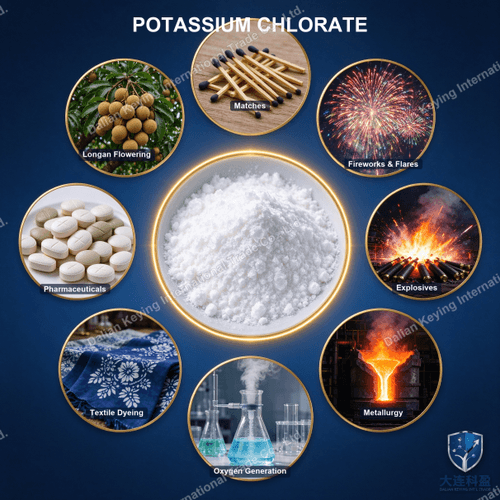
Specialty signal compositions, oxidizing mordants, textile and fiber bleaching auxiliaries, fine chemical oxidation intermediates, analytical oxidizing agents, agricultural oxidative herbicide raw materials, and laboratory synthesis.
Packaging & Storage
Standard: 25kg fiber drums / iron drums. Store in a sealed, light-protected, cool, and dry warehouse dedicated to oxidizers. Keep away from heat and ignition sources. Strictly prohibited from being stored or transported with sulfur, phosphorus, metal powders, organic matter, or acids.
Safety Notes
This product is a strong oxidizer; impact, friction, or heat can accelerate decomposition. Mixing with reducing agents significantly increases reaction risks. Clients must conduct compatibility testing prior to formulation development.